
Walk into most church fellowship halls or school maintenance closets in Burnet County and ask who’s in charge of the roof. You’ll usually get a name, then a pause, then a correction. The facilities chair rotated off the board last spring. The maintenance director retired and the new one is still learning which key opens the roof hatch. The person who knew the roof got patched above the choir loft in 2019 moved to Marble Falls, and nobody wrote it down.
That’s the real problem with church and school roofs out here. The buildings themselves are usually solid. Plenty of the sanctuaries around Burnet, Bertram, and Marble Falls have stood for decades, and the school campuses have grown wing by wing. What wears out first is the memory of who’s watching the roof and when. A roof tune-up schedule that lives on paper, tied to the building’s own calendar, outlasts any one volunteer or staff member.
We’ve worked on enough community buildings across the Hill Country to know that a roof almost never fails all at once. It fails in small, quiet ways over several seasons, and the first person to notice is usually a teacher staring at a brown ceiling tile or a deacon finding a bucket’s worth of water on the fellowship hall floor after Sunday service.
Why Commercial Roofing Maintenance Looks Different for Schools and Churches
A retail building or a warehouse has one owner, one budget, and someone whose job it is to answer for the roof. Schools and churches rarely work that way. Decisions go through a board, a committee, a bond election, or a congregation vote, and money for building upkeep competes directly with ministry, programs, and payroll. So commercial roofing maintenance gets pushed back until it becomes an emergency, and emergencies are the most expensive way to take care of a roof.
The buildings are also harder to work on than a typical commercial property. A single church campus might have a steep metal roof over the sanctuary, a low-slope membrane over the education wing added in the 1980s, and shingles on the parsonage. A school might have four or five roof sections built in different decades with different materials and different drains. Each of those systems ages on its own timeline, and a tune-up has to treat them separately instead of as one roof.
Then there’s the calendar. Schools can’t have a crew walking over occupied classrooms during testing week, and churches don’t want hammering during a funeral or a Wednesday night service. Good maintenance planning works around those dates from the start.
What Burnet County Weather Does to Community Buildings
Burnet County sits in a spot that gets a little of everything. Spring hail comes through the Highland Lakes area hard enough to dent metal panels and knock granules off shingles. Wind picks up across Lake Buchanan and Inks Lake and works on loose flashing and ridge caps. Summer heat bakes low-slope membranes day after day, and then a January cold snap makes everything contract fast.
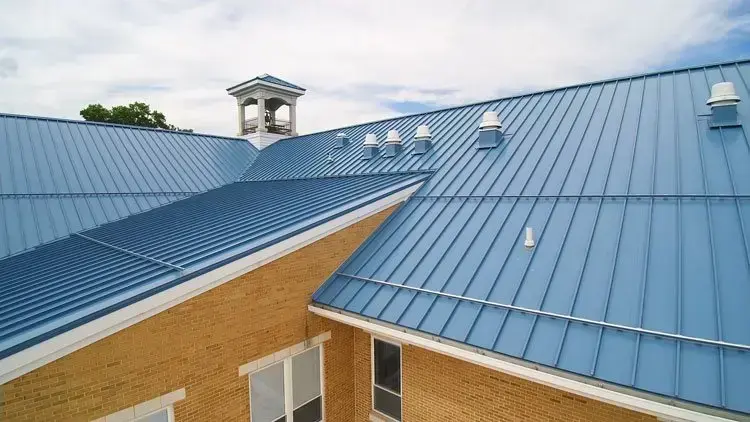
Metal roofs, which are common on Hill Country churches, handle a lot of that well, but the fasteners don’t. Exposed-fastener metal panels rely on rubber washers that dry out and crack after years of sun. Once those washers go, every screw becomes a small leak point, and on a big sanctuary roof that can mean hundreds of them. Low-slope sections over school wings deal with a different enemy: standing water. Leaves from live oaks and debris from spring storms clog drains and scuppers, water ponds, and the membrane starts breaking down underneath it.
Old limestone and masonry walls, which plenty of historic buildings in Burnet have, add another wrinkle. Where a roof meets a stone parapet or chimney, the flashing has to move with a wall that expands and contracts differently from the roof. Those joints are where we find some of the oldest, most-patched leaks on community buildings.
What a Commercial Roof Tune-Up Should Cover
A proper roof tune-up on a school or church goes section by section and system by system. The goal is to find small problems before they turn into water inside the building, and to leave behind a written record the next person in charge can pick up and use.
Metal Roof Sections
On metal roofs, we check fasteners and washers across the field of the roof, reseal or replace the ones that are failing, and look closely at seams, ridge caps, and trim. We also look for spots where panels have shifted or where hail left dents deep enough to change how water sheds. Standing seam roofs get their clips and seams checked, and sealant at every penetration gets inspected for cracking.
Low-Slope and Flat Sections
For TPO, modified bitumen, or built-up roofs, we clear drains and scuppers, look for ponding, and check every seam for lifting or separation. HVAC curbs, vent stacks, and skylights get a close look, since rooftop units on schools get serviced often and technicians sometimes disturb the flashing without noticing.
Shingle Sections, Gutters, and Flashing
Parsonages, fellowship halls, and portable classrooms often have shingle roofs that need the same attention as a house: lifted or missing shingles, exposed nails, worn pipe boots, and valley wear. Gutters and downspouts across the whole campus get cleared and checked, because on a big building an overflowing gutter can push water into walls and foundations fast. Flashing at walls, parapets, steeples, and bell towers rounds out the list.
The Written Report
Every tune-up should end with photos and a plain-language report, broken out by roof section, showing what we fixed that day and what should be budgeted for later. That report is what lets a finance committee plan two or three years ahead instead of reacting to a leak.
Building a Maintenance Schedule That Outlasts Committee Turnover
The most reliable fix for the turnover problem is a schedule tied to the building’s calendar instead of a person’s memory. For most schools in Burnet County, that means one tune-up during summer break and a quick check after spring storm season. For churches, a spring and fall visit on weekdays usually keeps us out of everyone’s way.
We recommend keeping a roof binder or shared folder with installation dates, warranty paperwork, past repair records, and every tune-up report. When a new facilities chair or maintenance director comes on, that folder tells them where the roof stands in ten minutes. It also matters a great deal when a hailstorm hits and an insurance claim follows, because a documented maintenance history makes it much harder for an adjuster to write off damage as neglect.
When a section does reach the end of its life, those same records help the board plan a replacement instead of scrambling for one. Most of our replacement jobs on smaller buildings wrap up in a single day, and on larger campuses we phase the work around services and class schedules so the building stays usable.
How We Work With Boards, Committees, and Staff
We know the person calling us often isn’t the person who signs off on the budget. So we put everything in writing, walk whoever wants to see it through the photos, and keep our findings honest. If a roof has five good years left with some upkeep, we’ll say so. If a section is failing, we’ll show you exactly why and what it costs to address it now versus later.
Our warranty covers labor and materials, because most roof problems trace back to how something was installed rather than the product itself. And for every inspection we perform, we donate $50 to the Roof-A-Vet fund, which helps put new roofs over veterans’ homes here in Central Texas. For a church or school that already serves its community, we think that’s a partnership worth mentioning. You can see more of our work around the county on our Burnet roofing services page.
Frequently Asked Questions
How often should a church or school roof in Burnet County get a tune-up? Twice a year is a good baseline, usually once in spring and once in fall, plus a check after any major hailstorm. Campuses with several roof types or older metal roofs benefit most from that rhythm.
Can a roof tune-up be scheduled around services and class times? Yes. We plan school work around summer break or after hours and church work on weekdays, so the building stays usable and nobody’s sermon gets interrupted.
Does regular commercial roofing maintenance help with insurance claims? It does. A documented maintenance history shows the roof was cared for, which makes it harder for an insurance company to blame storm damage on neglect.
What does a commercial roof tune-up cost for a church or school? It depends on the size of the campus and how many roof sections and materials are involved. We give a clear written quote after walking the property, and a tune-up almost always costs far less than the water damage it prevents.
Let’s Put Your Roof on a Schedule
Burnet County schools and churches take care of a lot of people. We’d like to help take care of the roof over them, with honest findings, clear records, and work that holds up long after the committee changes hands.
Call us at (254) 300-1413 or reach out here to schedule a free inspection.
If your roof is in danger, call the Lone Ranger.