
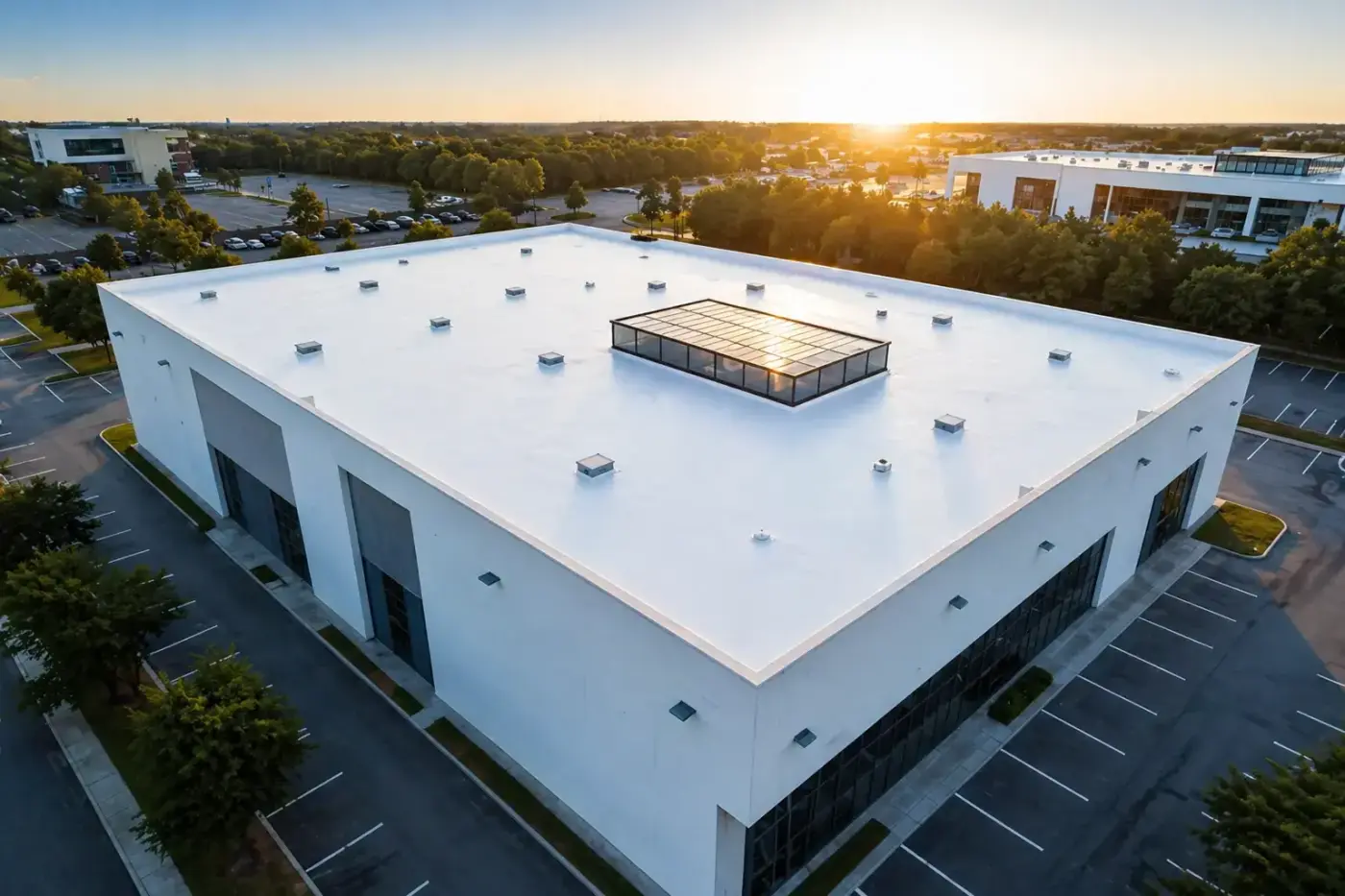
A warehouse roof in Dallas doesn’t fail quietly. When a seam opens up over a distribution floor or a membrane splits after a summer of triple-digit heat, the leak isn’t the real cost. The real cost is the pallets that get pulled off the floor, the racking that has to be tarped, the shift that gets sent home because water is coming through onto inventory that can’t get wet. For a warehouse operator, a roof isn’t a maintenance line item sitting off to the side. It’s tied directly to whether the building keeps running.
That’s the lens Dallas warehouse owners need when they’re choosing a commercial roofing system, and it’s a different lens than the one most roofing conversations start with. The question isn’t “what does this cost to install.” It’s “what keeps this roof from becoming the reason operations stop.” We’ve worked enough commercial roofs across North Texas to know those two questions don’t always point to the same answer, and the gap between them is where a lot of warehouse owners get steered wrong.
Why TPO Has Become the Default for Dallas Warehouses
TPO, or thermoplastic polyolefin, has become the most common membrane on large flat commercial roofs for reasons that hold up under a Dallas summer specifically. The white reflective surface pushes back a meaningful amount of solar heat, which matters on a building with acres of uninterrupted roof surface and an HVAC system already working overtime from May through September. Less heat load on the membrane also means less thermal cycling stress over the life of the roof, which is one of the more common ways flat roofs age poorly in this climate.
The seams matter as much as the material. TPO sheets get heat-welded together rather than glued or taped, which creates a bonded seam that’s often stronger than the membrane itself. On a warehouse roof with dozens of rooftop HVAC units, skylights, and vent penetrations, seam integrity around all those points is usually where problems start first. A commercial roofing system that welds clean around penetrations buys an operator a lot fewer nights wondering whether tomorrow’s rain is going to be a problem.
TPO also installs relatively fast for the square footage it covers, which lines up with how warehouse owners actually think about roof work. Downtime on a distribution building isn’t measured in a homeowner’s inconvenience. It’s measured in trucks that can’t load and inventory that has to be relocated. A TPO roofing system that gets installed and closed in efficiently keeps that disruption to a minimum.
Where Metal and Modified Bitumen Still Fit
TPO isn’t the sole system that makes sense on a Dallas warehouse, and it’s worth being straight about where it isn’t the right call. Buildings with a lot of rooftop equipment, frequent foot traffic for maintenance, or a design that calls for a standing seam profile often do better with a metal roofing system, which handles impact and wear from repeated access better than a membrane does. Metal also holds up longer under Dallas hailstorms in a lot of cases, which matters for a building that’s carrying commercial insurance and can’t afford a claim every storm season.
Modified bitumen still shows up on older warehouse buildings, usually as part of the roof they were built with rather than something we’d recommend fresh in most cases today. It’s a durable system in its own right, but it doesn’t offer the same reflectivity or seam performance as TPO, and on a large flat roof that difference shows up on the energy bill and in how the roof ages.
The honest answer for most Dallas warehouse owners planning new construction or a full tear-off is that TPO wins on cost, install speed, and heat performance for a straightforward flat commercial roof, while metal earns its place on buildings with heavier equipment loads or a design that calls for it. We walk the roof, look at what’s actually up there, and tell an owner which system fits their building rather than pushing whichever one is easiest to sell.
What a Warehouse Roof Actually Needs to Hold Up
A warehouse roof spends its life doing things a homeowner’s roof never has to. It supports rooftop units that get serviced regularly, foot traffic from maintenance crews, and drainage systems that have to move a lot of water off a large flat surface fast during a Dallas downpour. Any commercial roofing system installed without accounting for that reality starts failing at the details long before the membrane itself gives out.
Drainage is usually the first thing we check on an existing Dallas warehouse roof, because a flat roof that doesn’t shed water fast enough will pond, and ponding water shortens the life of any membrane sitting under it. Flashing around parapet walls, HVAC curbs, and roof penetrations is the second thing, since that’s where a roof’s weak points concentrate. A roof inspection that actually gets on the roof and checks these points tells an owner more about the real condition of a warehouse roof than a walkthrough from the ground ever will.
Storm damage adds another layer specific to this region. Hail moves through the Dallas-Fort Worth area with enough regularity that a warehouse roof needs to be checked after every significant storm rather than waiting for a leak to show up first. Storm damage repair on a commercial membrane often starts as something small, a puncture or a seam that’s been stressed, and it’s a lot cheaper to catch that early than to wait for it to become a full section replacement.
Planning a Roof Project Around Business Continuity
Every warehouse roof project we take on in the Dallas area gets planned around one question the owner cares about more than any spec sheet: how do we keep the building operating while this work happens. That means sequencing the roof in sections when the building layout allows for it, working around loading dock schedules, and being upfront about what a full tear-off requires versus what can be handled as a targeted repair.
We’ve sat across the table with enough Dallas property owners and facility managers to know that most of them aren’t looking for the roof with the most impressive material spec. They’re looking for a straight answer about what their building needs, a realistic timeline, and a crew that shows up and does the work as planned. That’s the standard we hold every commercial job to, on warehouses and everywhere else we work in North Texas.
Frequently Asked Questions
How long does a TPO roof last on a Dallas warehouse? A properly installed TPO system typically holds up for 20 to 30 years, though Dallas heat and hail exposure make regular inspections important to catch small issues before they shorten that lifespan.
Is TPO more expensive than other commercial roofing options upfront? TPO is usually competitive with or less expensive than metal roofing for the same square footage, though the right choice depends on the building’s specific equipment load and design.
Can a warehouse stay operational during a roof replacement? In most cases, yes. We sequence commercial roof work in sections and coordinate around loading dock and operational schedules so the building keeps running.
How often should a warehouse roof be inspected in Dallas? We recommend at least once a year, plus an additional check after any major hailstorm, since Dallas sees enough severe weather that damage can accumulate between scheduled inspections.
Ready to Talk Through Your Warehouse Roof
Dallas warehouse owners count on us to give them a straight assessment of what their roof needs and a plan that keeps the building running while we do the work. That’s the standard, every time.
Call us at (254) 300-1413 or reach out here to schedule a commercial roof assessment.
If your roof is in danger, call the Lone Ranger.